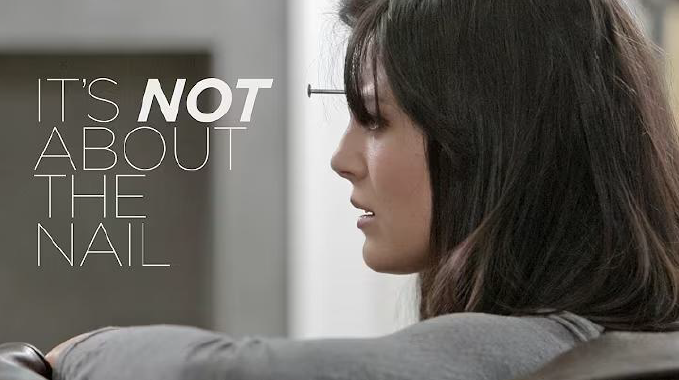
“There’s all this pressure, you know? And sometimes it feels like it’s right up on me.”
So begins a YouTube video created by Jason Headley in 2013 called “It’s Not About The Nail.” The 2-minute clip with nearly 30M views shows a woman complaining to a man about the relentless pressure she’s experiencing in her head.
The man is struggling to respond empathetically, and as the camera angle changes, we viewers can see quite clearly what he’s seeing: The woman has a large nail protruding from her forehead.
“Well, you do have a nail in your head,” he tells her. He suggests they remove the nail.
She responds with a heavy sigh, an eyeroll, and says, “It is not about the nail!” She accuses him of always being in fix-it mode. “What I really need is for you to just listen!”
It’s a funny video, but also instructive because all of us need reminders to just listen to each other.
Here at the Dementia Institute, we’ve been using “It’s Not About the Nail” as an educational tool with our staff. When we are responding to people living with dementia who are in distress, the best thing we can do is to listen, empathize, and validate.
Validation. That’s the process of actively listening to someone’s concerns, using their words to reflect back, mirroring some of their distress, and then saying “That sounds hard” or “Oh! I’m sorry you’re feeling _____,” or “Tell me more about that.”
Where this gets tricky, though, is when you need to validate someone who has a different understanding of reality. For example, when an 85-year-old woman is crying because she can’t find her mother, how do you respond?
In the past, many of us were taught to use reality orientation: in other words, reorienting that person to what we know is real. So in the case of the woman seeking her mom, we might have said, “Now, Marcia, you know that your mom died quite a long time ago.”
But reality orientation doesn’t work with people who have dementia. The changes occurring in their brains prevent them from comprehending logic in the same way we do.
And that reality may very well be traumatizing. (Imagine Marcia crying even harder, “My mom?! She died?!” And it will be repeated endlessly, because later in the day Marcia is not going to remember this conversation. So she will still be looking for her mother, and if you again explain that her mom is dead… You get the picture.)
So the best way to respond to Marcia? Try this: “Marcia, you’re looking for your mom! Tell me about your mom.” Allow Marcia to talk about her mom, not necessarily where she is, but who she is.
Maybe Marcia’s mom made award-winning pies for the county fair. Maybe she was an incredible seamstress. Maybe Marcia’s mom raised seven children during the Great Depression, and, boy, that was hard work! Engaging Marcia in talking about her mom will allow her to revisit those memories without the stressful rumination of trying to find her.
Rosemary Apol-Hoezee, RN, MPH, CPHRM, CDP
Dementia Specialist with the Dementia Institute
Info@Dementia-Institute.org